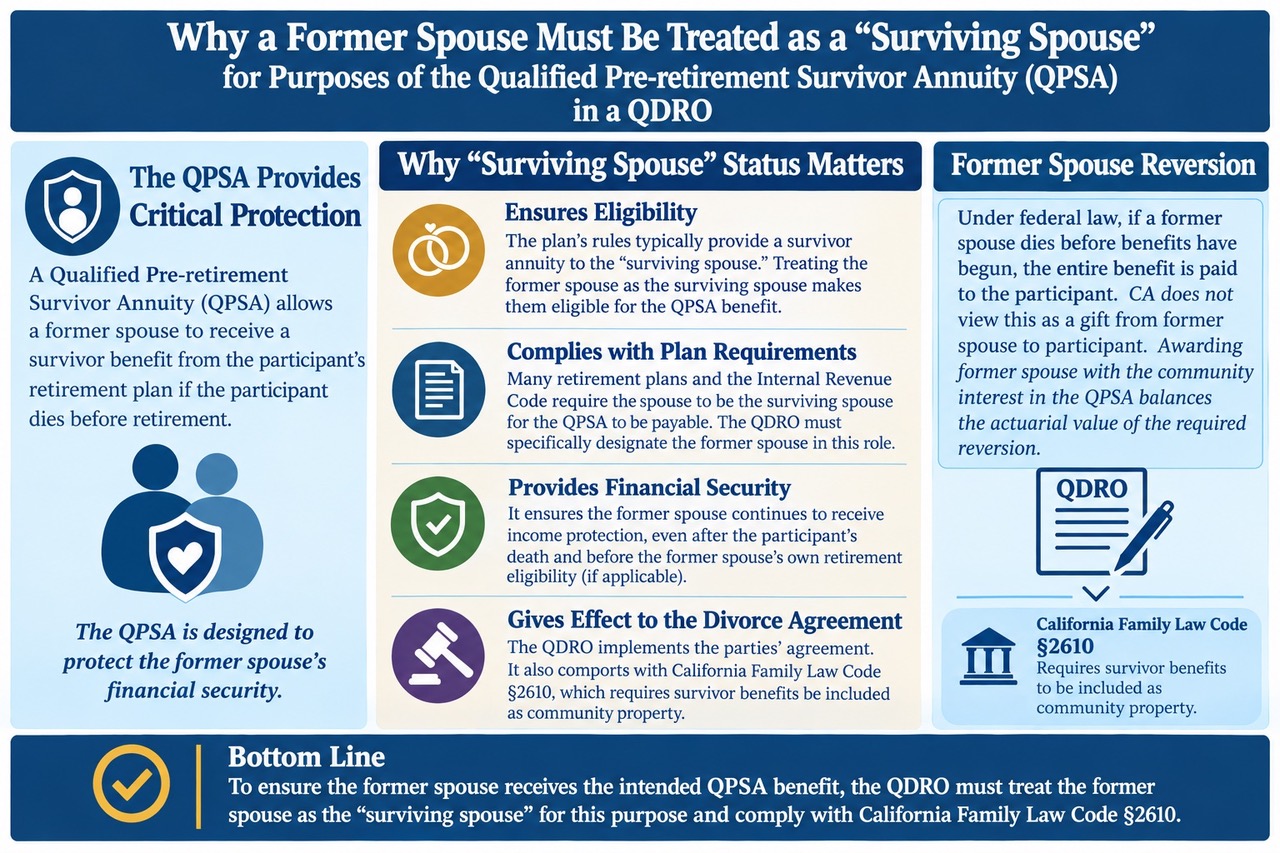
Protecting QPSA Benefits After Divorce: Why “Surviving Spouse” Status Matters
Dividing a pension in a divorce involves more than deciding who receives a share of future retirement payments. The division should also address what happens if the employee spouse dies before those payments begin.
For retirement plans that provide a Qualified Preretirement Survivor Annuity, or QPSA, a properly drafted Qualified Domestic Relations Order, or QDRO, can preserve an important source of financial protection for a former spouse.
What Is a QPSA?
A QPSA generally provides a lifetime survivor annuity when a participant with vested retirement benefits dies before the participant’s retirement benefit payments begin. It applies to defined benefit pension plans and certain defined contribution plans; other plans may provide different death benefits.
For a former spouse who expects to rely on retirement income awarded in a divorce, this protection can help safeguard future financial security. Eligibility and payment timing depend on the applicable law, plan provisions, and order. IRS guidance on QPSAs.
Why “Surviving Spouse” Language Matters
Divorce generally ends a spouse’s automatic entitlement to QPSA benefits. Federal law, however, permits a QDRO to treat a former spouse as the participant’s surviving spouse for all or a portion of those benefits.
That designation matters because awarding a share of retirement benefits does not, by itself, establish the intended QPSA protection. When the former spouse is to receive a QPSA, the order should expressly identify that entitlement and specify its scope.
The phrase “surviving spouse” serves a particular legal purpose here: it allows the former spouse to retain the survivor rights assigned by the QDRO after the marriage has ended. Department of Labor guidance on survivor benefits.
How California Law Protects Community Property Rights
California Family Code §2610 directs courts to make necessary or appropriate orders ensuring that each party receives their full community property share of retirement benefits, including survivor and death benefits.
The statute also permits a court to order a survivor annuity election when the plan offers that option, subject to limits that prohibit requiring increased benefits based on actuarial value.
For California divorces, survivor benefits therefore deserve specific attention when implementing the retirement division. The order should account for these rights alongside the allocation of retirement payments. California Family Code §2610.
What If the Former Spouse Dies First?
The retirement division should also address the reverse situation: the former spouse dies before receiving benefits.
Depending on the plan and the QDRO, the assigned interest may revert to the participant, pass to an eligible contingent alternate payee, or receive another treatment permitted by the plan. Reversion is not a universal federal requirement. PBGC’s model orders, for example, address different outcomes depending on the order’s provisions. PBGC’s QDRO guide.
These provisions should be considered together so the order clearly addresses the consequences of either party’s death.
A carefully drafted QDRO translates the retirement division into enforceable plan instructions. When QPSA protection is intended, expressly treating the former spouse as the surviving spouse for the assigned benefit helps preserve the financial security the divorce agreement was meant to provide.